
Why this stage matters
Most Salesforce project pain starts before a single line of Apex is written. Teams lose time when workshop notes are vague, when business language is not translated into platform capabilities, or when architecture decisions are made without enough delivery realism. That is why discovery and solution design are high-value AI use cases.
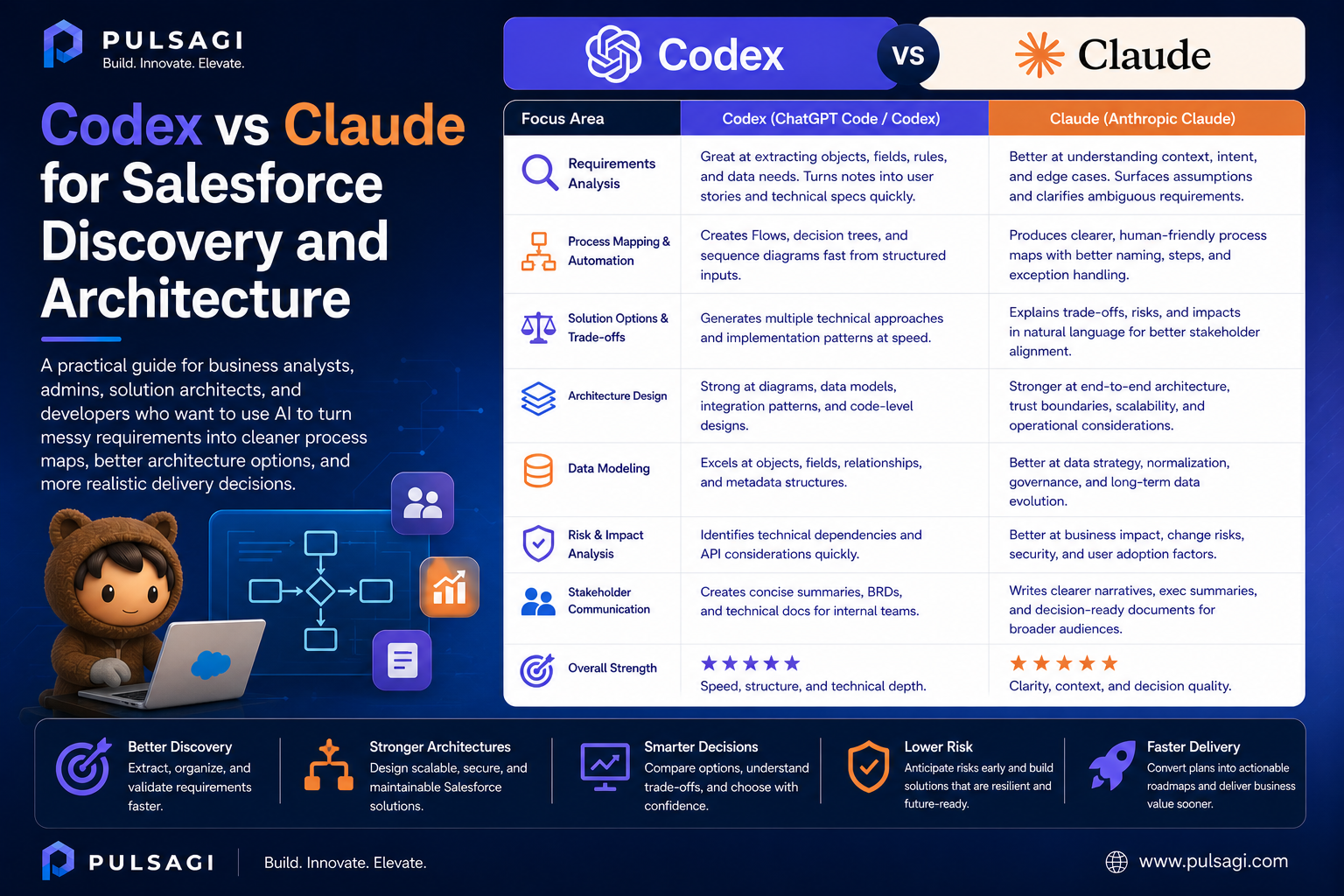
Claude is usually the stronger starting point here because discovery work is full of ambiguity, conflicting stakeholder language, and half-formed requirements. Codex becomes valuable as soon as those ideas need technical pressure-testing against existing metadata, code patterns, or delivery constraints.
Using AI in discovery
Discovery is where AI can save teams from shallow requirements. A good assistant should not just rewrite notes. It should surface missing decisions, exception paths, user roles, integration dependencies, reporting needs, and security implications.
| Discovery artifact | How Claude helps | How Codex helps |
|---|---|---|
| Workshop notes | Turns raw notes into epics, stories, assumptions, and open questions | Checks whether current repo or metadata already solves part of the requirement |
| Process maps | Clarifies happy path, exceptions, approvals, and ownership | Flags automation complexity or likely technical bottlenecks |
| User stories | Improves acceptance criteria and business language | Tests whether stories are implementable without hidden technical debt |
| Gap analysis | Explains standard versus custom choices in plain language | Validates likely impact on Apex, Flow, integrations, or packaging |
For example, in lead management discovery, Claude can quickly turn stakeholder statements into routing scenarios, dedupe questions, SLA definitions, and reporting needs. Codex can then look at the existing org or repository and point out whether the current trigger framework, Flow footprint, or duplicate handling pattern will make those requirements easy or expensive.
Using AI in architecture
Architecture work benefits from AI when the team needs option analysis, not when it wants blind certainty. The best outputs compare a standard-first approach against a hybrid or custom path, then explain the tradeoffs in maintainability, performance, support ownership, and security.
| Architecture question | What strong AI support looks like |
|---|---|
| Standard versus custom | Option matrix covering native Salesforce, Flow, Apex, and external system ownership |
| Object model design | Clear entity boundaries, ownership rules, reporting consequences, and migration impact |
| Automation strategy | Flow versus Apex recommendations with scale and maintainability tradeoffs |
| Integration design | System-of-record mapping, sync versus async guidance, retries, and support model clarity |
| Non-functional requirements | Volume, latency, observability, auditability, and support readiness captured early |
From an architecture perspective, Claude is usually better at the narrative: why an option exists, what it costs, and what business tradeoff it creates. Codex is more useful once the design needs a reality check against actual implementation patterns such as bulk processing, event handling, sharing design, or existing technical debt.
Admin and developer perspective
Admin perspective
Admins should use AI to keep discovery grounded in standard Salesforce features. That means object reuse, cleaner reporting design, manageable Flow architecture, and maintainable permission strategies. Claude is especially useful for standard-first framing and requirement clarification.
Developer perspective
Developers should use AI to challenge hidden build cost. Codex is helpful when a story sounds simple but really implies async orchestration, cross-object recursion risk, unselective queries, external dependency handling, or test complexity.
Architects should be careful not to let either tool become the final authority. AI should improve the quality of the discussion, not replace architectural ownership.
Best practices and limitations
- Ask for assumptions, not just answers.
- Require every design option to include risks, dependencies, and support implications.
- Use Codex to validate feasibility when the team already has repository or metadata context.
- Do not accept AI guidance on security, sharing, or compliance without human review.
- Do not let "best practice" replace org-specific constraints such as licensing, regional rollout, or data ownership.
The main limitation here is false confidence. Discovery output can sound complete while still missing business nuance. Architecture output can sound mature while still ignoring practical delivery friction. That is why human review is still essential.
Recommendation
For Salesforce discovery and architecture, start with Claude for workshop synthesis, requirement shaping, and option framing. Bring in Codex once you need to test the design against existing patterns, technical constraints, or implementation cost. That handoff usually produces better stories, better architecture, and fewer late surprises.