
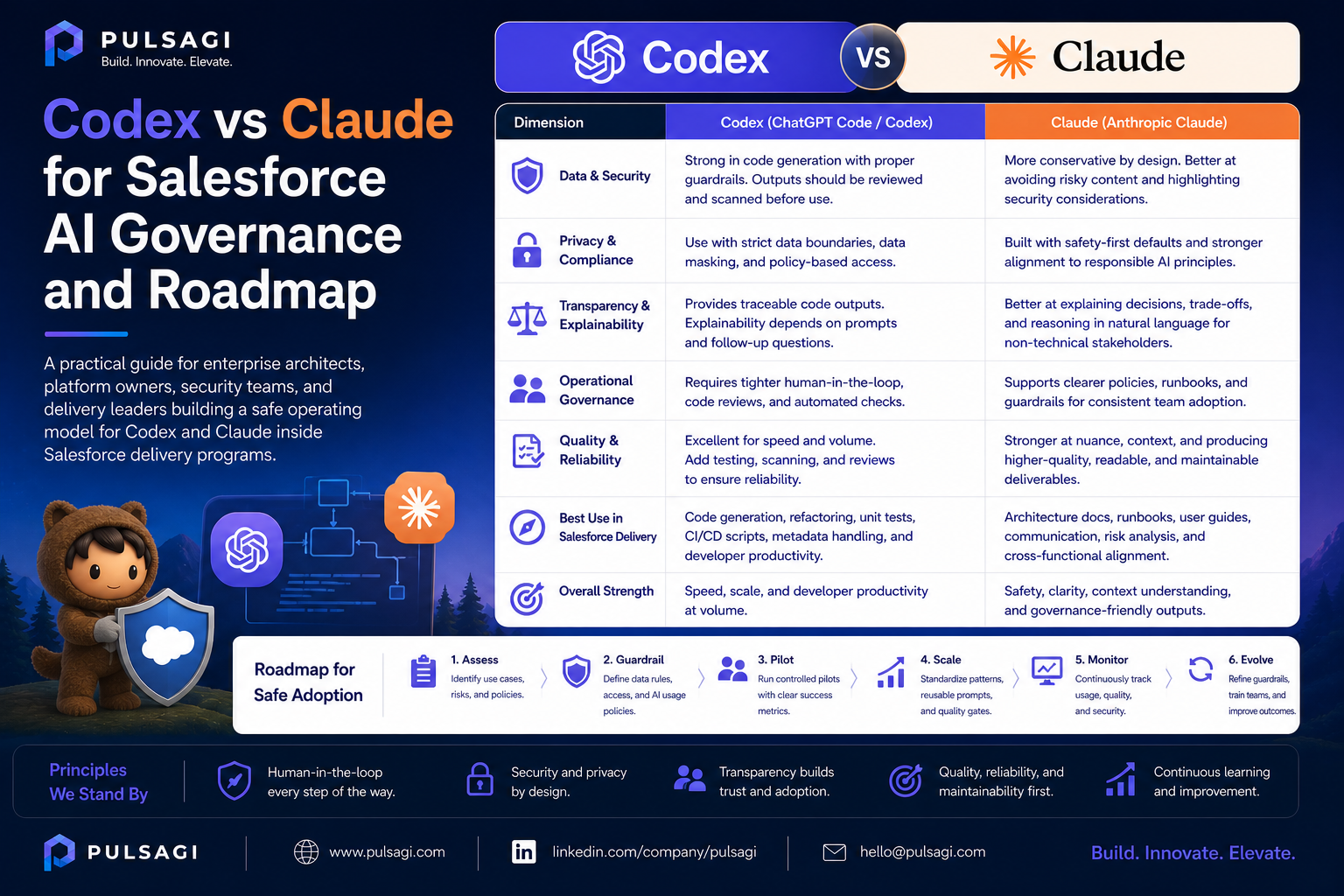
Why governance matters
AI creates the most value in Salesforce when teams standardize how they use it. Without governance, the same tool that speeds up design and coding can also leak sensitive data, create unreviewed automation, or publish polished but inaccurate documentation. Governance is what turns experimentation into a repeatable delivery capability.
Codex and Claude do not need radically different security policies, but they do need different usage guidance. Codex is closer to implementation and code execution. Claude is closer to large-context synthesis and communication. The review checkpoints should reflect that difference.
Operating model and controls
A workable Salesforce AI operating model should define approved use cases, prohibited inputs, signoff rules, and role-specific guidance. Admins, developers, architects, QA, and support teams do not all need the same AI playbook.
| Control area | What good looks like |
|---|---|
| Acceptable use | Clear guidance on where AI can draft, where it can assist, and where humans must decide |
| Data handling | No secrets, no raw tokens, and no unnecessary production data in prompts |
| Review model | Mandatory review for code, automation, security design, migration plans, and stakeholder communication |
| Template library | Approved prompt patterns for stories, architecture, tests, release notes, and support |
| Traceability | Store validated outputs in version control or a controlled documentation repository |
Security, compliance, and quality
Salesforce programs often touch customer data, pricing, case history, regulated workflows, or integration credentials. That means AI governance has to start with data classification and prompt hygiene.
- Never paste secrets, certificates, or access tokens into prompts.
- Redact or minimize production data, especially when PII or sensitive business context is involved.
- Require named human signoff for Apex, Flow, sharing design, external auth, and customer-facing communication.
- Audit recurring AI workflows so teams know which prompts and outputs are approved.
Adoption roadmap and KPIs
Most teams should not roll AI out to every Salesforce workstream at once. A better sequence is to start with low-risk drafting and review support, then expand into implementation and operational use once prompt patterns and review controls are stable.
| Phase | Recommended focus | Success measure |
|---|---|---|
| Pilot | Stories, architecture summaries, test cases, release notes | Faster drafting without quality drop |
| Standardize | Prompt templates, review checklists, role guidance | Repeatable outputs across teams |
| Scale | Implementation support, QA acceleration, support workflows | Measured time savings and lower rework |
| Optimize | KPI review, incident learning, better templates | Sustained value with controlled risk |
Useful KPIs include story turnaround time, first-pass design document completion time, test drafting time, release-note preparation time, onboarding speed, and RCA turnaround time. The goal is not prompt volume. The goal is better delivery economics with controlled risk.
Limitations and failure modes
- Fluent output can hide weak assumptions.
- Unreviewed AI code can create security or bulkification defects.
- Business summaries can sound persuasive while missing org-specific constraints.
- Over-reliance on one tool can make teams skip technical or operational validation.
These are not reasons to avoid AI. They are reasons to put guardrails around it.
Recommendation
Adopt Codex and Claude as complementary capabilities inside a governed Salesforce delivery model. Use Claude where synthesis, communication, and broad reasoning matter. Use Codex where implementation, repository context, review, and execution matter. Standardize prompts, review rules, and signoff paths before you try to scale usage enterprise-wide.