
Why this stage matters
Integrations, migration, QA, and release delivery are where Salesforce teams usually pay for weak design decisions. This is also where AI can create strong value if used with discipline. The work is structured enough for automation support, but high-risk enough that careless AI output can be expensive.
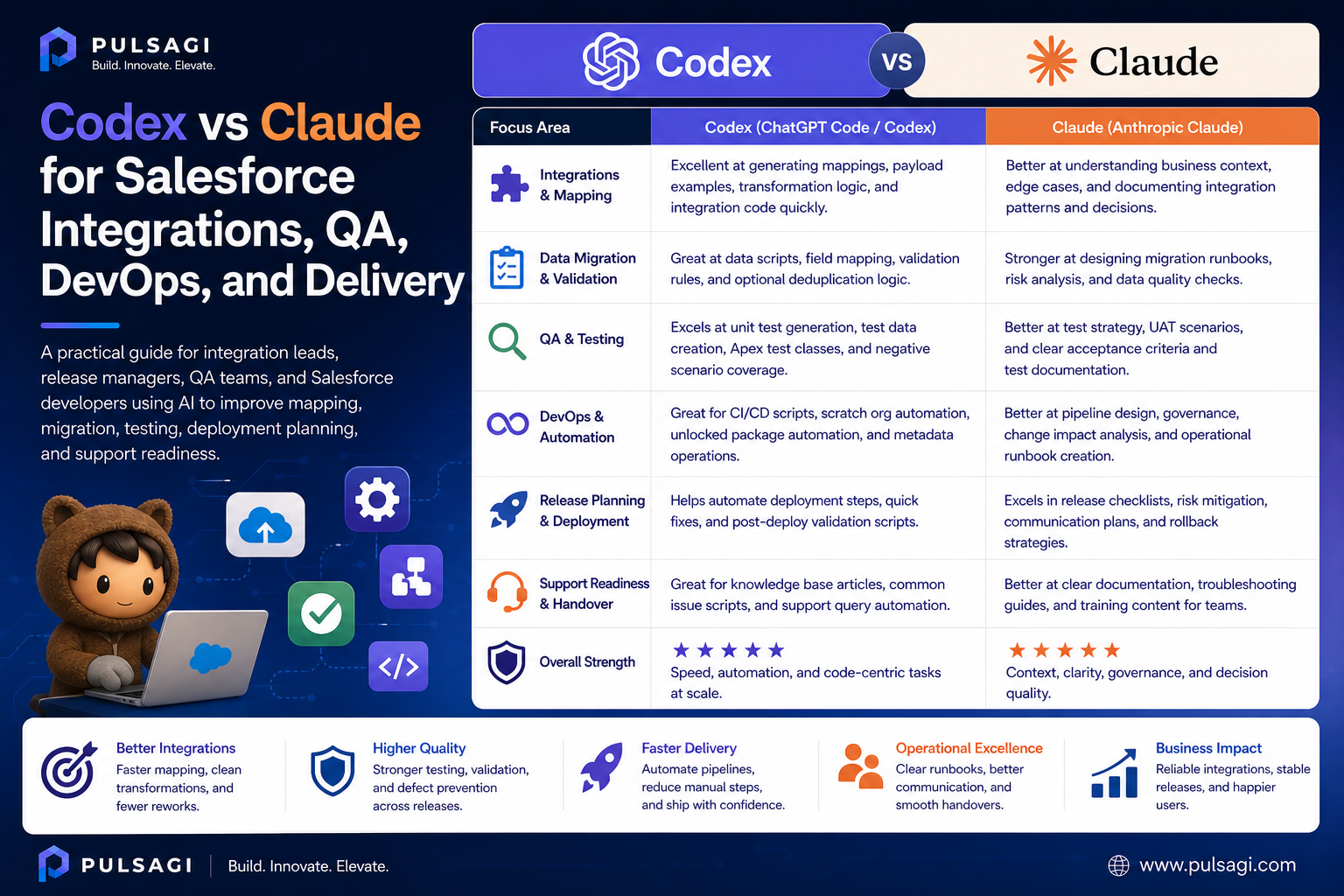
Claude is useful for mapping the end-to-end story: system ownership, retry logic, support model, release communications, and test strategy. Codex becomes especially useful when implementation detail matters, such as payload handling, callout structure, metadata changes, deployment scripts, and code-level risk review.
Integration design and delivery
Salesforce integrations involve more than payload samples. The important questions are usually around system of record, error handling, authentication, observability, and ownership. Claude helps teams express those decisions clearly. Codex helps validate whether the implementation can support them cleanly.
| Integration concern | Where AI helps |
|---|---|
| Payload mapping | Draft field mappings, default values, and transformation notes |
| Sync versus async design | Compare latency, retry, and support tradeoffs |
| Error handling | Define business errors, technical errors, and escalation paths |
| Authentication | Explain secure use of Named Credentials and external credential models |
| Support ownership | Clarify who owns failures across Salesforce, middleware, and source systems |
From an admin perspective, AI can help keep integration requirements readable. From a developer perspective, Codex is more useful when the team needs to reason about callouts, event processing, retries, mocks, and unit-test isolation.
Migration and data quality
Migration work benefits from AI because it is repetitive and document-heavy. Mapping sheets, load sequences, validation impacts, and reconciliation logic all have strong AI support potential. But migration is also where wrong assumptions can create business damage quickly.
- Use AI to draft source-to-target mapping logic and transformation rules.
- Use AI to identify dedupe strategies, default value decisions, and data survivorship rules.
- Use AI to build cutover and reconciliation checklists before the load begins.
- Do not let AI invent business meaning for unclear source values without human confirmation.
QA, DevOps, and release work
Testing and release preparation are some of the most practical Salesforce AI use cases. Claude can draft risk-based test suites, UAT scripts, smoke-test packs, and stakeholder-ready release notes. Codex is better for diff review, code-level risk analysis, metadata inspection, and technical validation of what actually changed.
| Delivery task | Best use of AI |
|---|---|
| Regression planning | Generate edge cases, role-based scenarios, and integration-failure coverage |
| Release checklist | Draft pre-deploy checks, smoke tests, backout criteria, and stakeholder communications |
| Metadata risk review | Highlight high-risk Flows, permissions, data scripts, and integration touchpoints |
| Support handoff | Create deployment summaries, known issues, and rollback context for operations teams |
Best practices and limitations
- Always ask AI to separate technical failure from business impact.
- Require explicit retry, timeout, logging, and support ownership thinking in integration designs.
- For QA, ask for positive, negative, role-based, and integration-dependent scenarios.
- For releases, ask for rollback conditions and communication drafts, not only deployment steps.
- Never trust generated migration assumptions without source-data validation.
The biggest limitation is false completeness. AI can produce a good-looking release or migration artifact that still misses one critical org-specific dependency. That is why technical and operational signoff still matters.
Recommendation
Use Claude to structure the delivery story: system boundaries, business impact, test strategy, and release communication. Use Codex when the team needs exact technical review, implementation alignment, or defect isolation. For Salesforce delivery, that combination is more reliable than trying to force one tool to handle every stage equally well.