
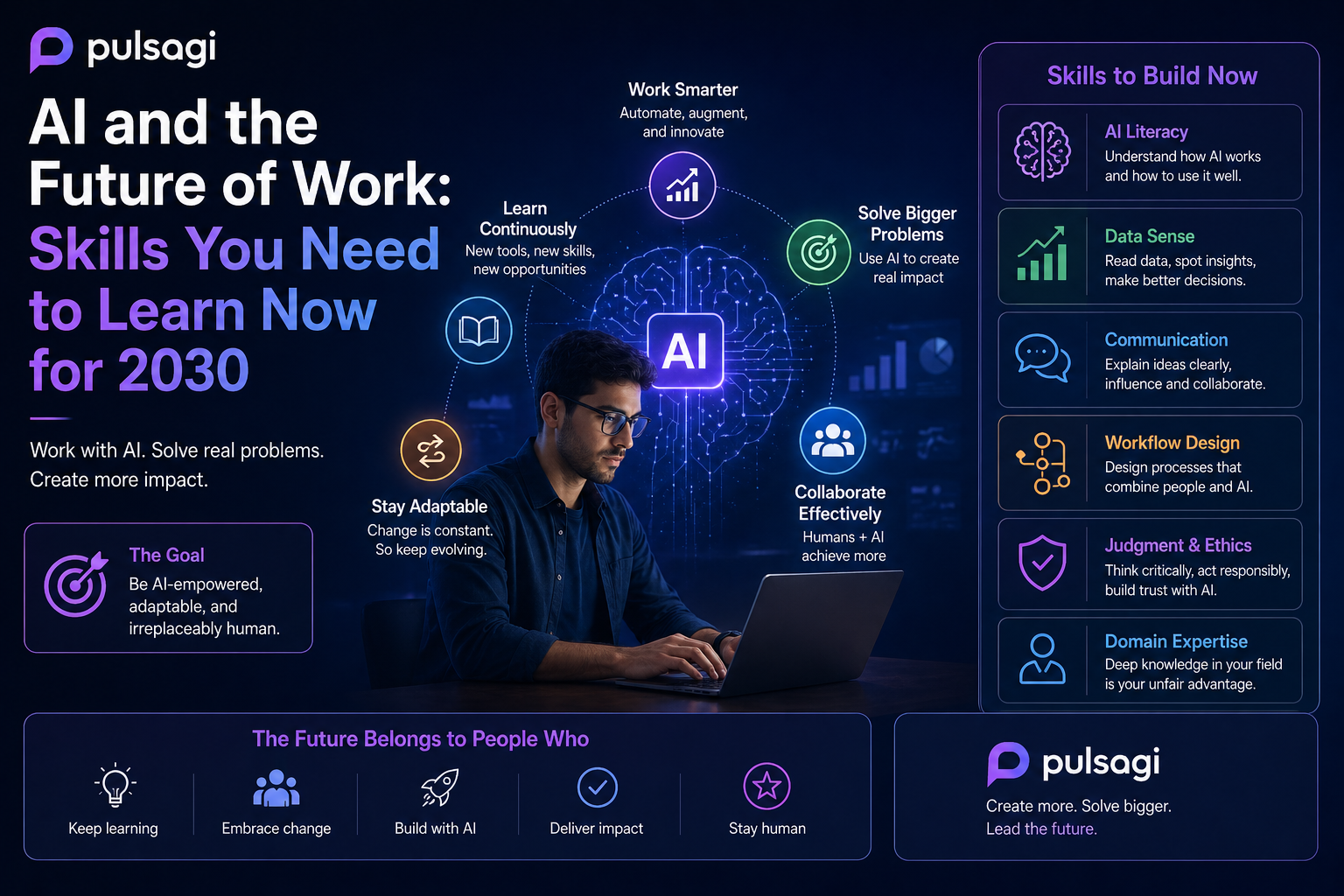
Introduction
AI is changing what work looks like, but it is also changing what makes someone valuable at work. The World Economic Forum's 2025 findings point to rapid growth in demand for technology skills such as AI, big data, and cybersecurity, while human skills like analytical thinking, resilience, leadership, and collaboration remain critical. That combination is the key signal.
This article was reviewed against institutional sources available on March 17, 2026.
Why skills are the real story
Most AI discussions focus on which jobs will disappear. That matters, but it is not the most actionable question for most professionals. The more useful question is: what skills will help me stay effective as tools, workflows, and expectations change?
The WEF says nearly 40% of skills required on the job are expected to change, and 59 out of 100 workers are projected to require reskilling or upskilling by 2030. That is why career resilience is now a learning strategy, not a passive hope.
Practical interpretation: a future-proof career is less about mastering one hot tool and more about becoming the kind of person who can learn, judge, adapt, and coordinate effectively in AI-rich environments.
The most important skills to learn
| Skill | Why it matters | How it shows up at work |
|---|---|---|
| AI literacy | You need to understand what AI can do, what it cannot do, and where it fails. | Choosing the right tool, asking better questions, spotting risky output, and using AI responsibly. |
| Analytical thinking | As AI handles more rote output, interpretation and reasoning become more valuable. | Breaking down problems, comparing options, and making evidence-based decisions. |
| Data fluency | Good AI work depends on context quality, metrics, and source awareness. | Reading dashboards, spotting bad inputs, checking evidence, and shaping better prompts or workflows. |
| Workflow design | AI creates value when it fits into real processes. | Knowing where AI should draft, where humans should review, and where approval or escalation is needed. |
| Communication | Humans still need to align teams, explain decisions, persuade stakeholders, and reduce confusion. | Writing clearer briefs, giving better feedback, and turning AI output into useful action. |
| Domain expertise | AI is strongest when guided by someone who understands the real work. | Recognizing whether an answer is correct, naive, risky, or unusable in context. |
| Evaluation and judgment | AI output must be reviewed, ranked, and sometimes rejected. | Checking accuracy, security, bias, feasibility, and business fit. |
| Adaptability and resilience | Tools will keep changing. Static skill plans will not last. | Learning new systems quickly and staying useful during transitions. |
How to build them
You do not need an extreme reinvention plan. Most people can build a strong AI-era skill profile in layers.
- Start with AI literacy: understand prompting, hallucinations, grounding, privacy, and the difference between automation and augmentation.
- Add data awareness: learn how information quality affects decisions, reports, and AI outputs.
- Practice workflow thinking: map where AI helps in your current job and where humans must stay accountable.
- Keep strengthening communication and judgment: these are the skills that scale across tools and industries.
- Deepen your domain: people with real industry knowledge usually benefit from AI faster than people with only shallow tool familiarity.
Role-based examples
Move beyond prompt tricks
A marketer should learn how to brief AI clearly, review output against brand rules, analyze campaign performance, and connect content production to conversion goals. The valuable skill is not "using ChatGPT." It is directing AI toward measurable marketing outcomes.
Learn process and policy, not just tools
An operations admin benefits by understanding where AI can summarize requests, classify tickets, retrieve SOPs, and draft responses. But the higher-value skill is knowing which steps need controls, approvals, and escalation.
Use AI to amplify engineering fundamentals
Developers gain the most when they pair AI tools with strong debugging, architecture, code review, testing, security awareness, and product reasoning. Pure code generation is not enough. System judgment is the durable edge.
Combine AI literacy with human facilitation
Educators do not only need to know AI tools. They need to know when to use them, when to disclose them, how to redesign assessment, and how to keep learners thinking rather than outsourcing too much of the process.
Admin and developer perspective
Career advice becomes more useful when grounded in role realities.
- Admins and operators: prioritize AI literacy, process design, documentation discipline, communication, and governance awareness.
- Developers: prioritize AI-assisted delivery, but keep investing in architecture, security, debugging, testing, and evaluation.
- Leaders: prioritize talent development, internal mobility, coaching, and building teams that can learn continuously.
Best practices
- Learn skills in combinations: AI literacy alone is weak without domain knowledge or judgment.
- Practice on real work: using AI on actual tasks teaches more than abstract tutorials.
- Document what works: save effective workflows, prompts, review patterns, and playbooks.
- Keep one human edge strong: writing, speaking, technical depth, leadership, or industry expertise.
- Review your skill stack every few months: AI-era learning is iterative.
Limitations
There is no universal skill list that fits every profession equally. Industry, geography, regulation, and seniority all matter.
- Tool churn is real: specific interfaces will change quickly.
- Not every worker gets equal access to training: reskilling gaps remain a real risk.
- Overspecialization can backfire: if you learn only one AI tool, your advantage may disappear fast.
- Human skills are harder to measure: but they often matter more over time.
Recommendation
If you want to future-proof your career, do not ask only which certification or AI tool to learn next. Ask which mix of skills makes you more useful in a team where AI is everywhere. For most people, the answer is a balanced mix of tool literacy, analytical reasoning, communication, process awareness, and domain expertise.
Start small, but start deliberately. Learn one AI workflow in your job, one data-checking habit, one stronger review habit, and one communication improvement. That compounds quickly.
My recommendation: build skills that let you direct AI, check AI, and integrate AI into valuable work. That is a much safer strategy than trying to compete with AI at repetitive output alone.