
Introduction
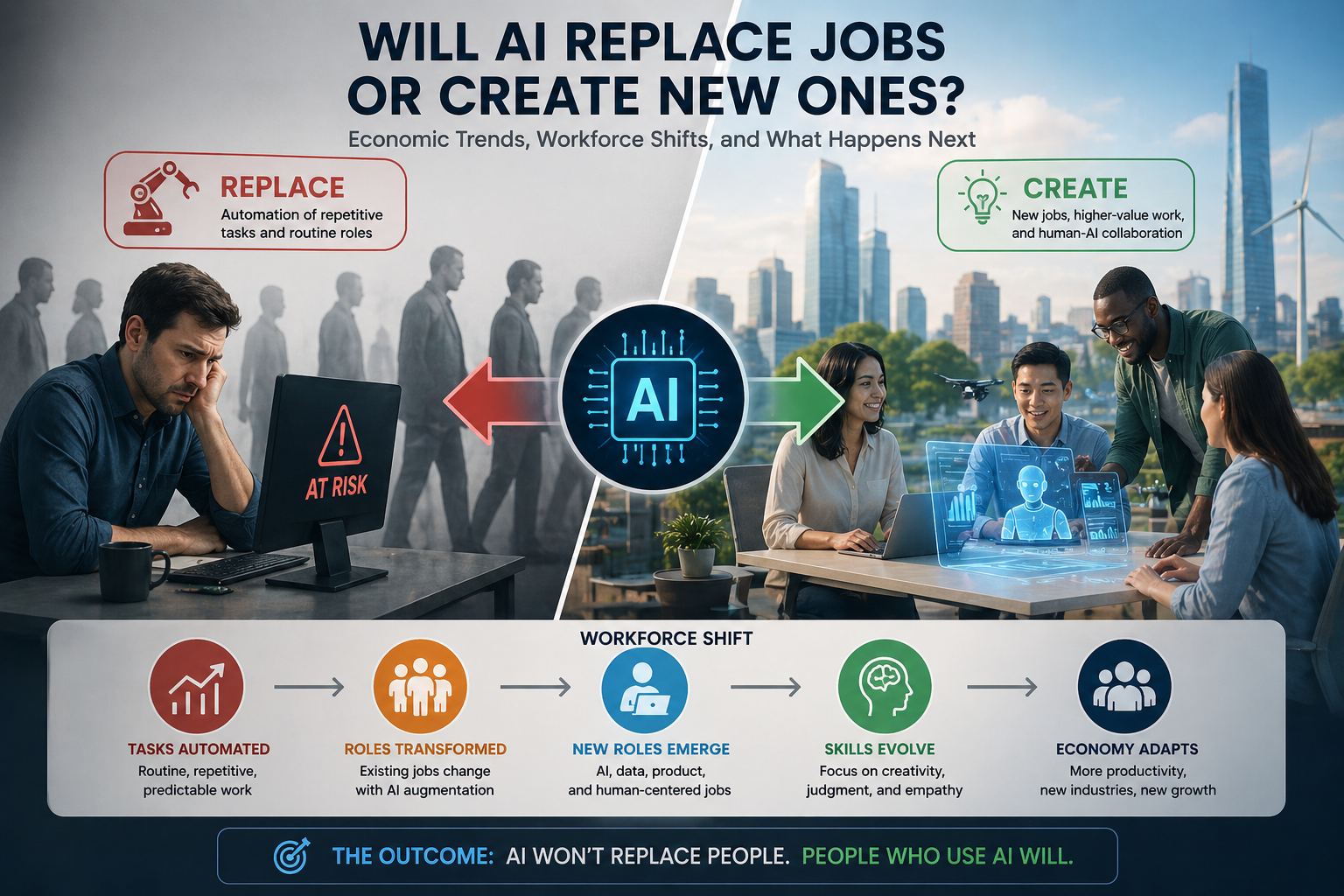
Headlines about AI and jobs often swing between two extremes: either AI will destroy work, or AI will create abundance without meaningful disruption. Both are too simple. In reality, AI affects tasks, workflows, business models, and organizational design. That means some jobs may decline, many jobs will change, and new roles will appear around governance, tooling, evaluation, integration, and human oversight.
This article was reviewed against institutional and report-based sources available on March 26, 2026, including the World Economic Forum, ILO, OECD, and IMF.
What this question really means
When people ask whether AI will replace jobs, they usually mean one of three things.
- Task replacement: can AI perform parts of the work faster or more cheaply?
- Role compression: can fewer people now do the same output because AI absorbs routine work?
- New demand creation: does AI create new products, workflows, tools, services, and oversight roles?
These can all happen at the same time. That is why the right lens is not "jobs yes or no." The right lens is which tasks, in which sectors, under which management choices.
Why it matters
This is not only an economist's question. It matters to workers deciding what to learn, managers deciding whether to automate, governments deciding how to support transitions, and technology teams deciding what sort of products to build.
Practical reality: the labor impact of AI is shaped not only by model capability, but by labor law, company incentives, skill gaps, internal mobility, union pressure, customer expectations, and whether AI is used to cut cost or create higher-value work.
What the current evidence says
| Source | Signal | What it suggests |
|---|---|---|
| WEF Future of Jobs Report 2025 | By 2030, 170 million new jobs are projected to be created and 92 million displaced, for a net gain of 78 million. | Disruption is real, but the aggregate outlook in the report is net positive rather than purely destructive. |
| ILO 2025 GenAI exposure index | One in four workers are in occupations with some GenAI exposure, but transformation is the most likely outcome for most jobs. | Exposure does not automatically equal redundancy. Human input still matters in most occupations. |
| OECD Employment Outlook 2023 | So far, AI appears to be affecting job quality and task composition more than job quantity. | In the near term, work redesign may be a more important effect than mass unemployment. |
| IMF 2024 Gen-AI note | AI may affect around 40% of global employment, with advanced economies more exposed. | Exposure is broad, but effects differ by geography, age, education level, and role type. |
The most important takeaway is that exposure is not the same as replacement. A role may be exposed because AI can automate some tasks within it, while the rest of the role becomes more valuable, more supervisory, or more customer-facing.
Where jobs may shrink and where they may grow
Based on current evidence, the most exposed work tends to share a few features: repeatable language output, structured digital tasks, templated documentation, low-complexity triage, and routine administrative processing.
Likely pressure zones include basic clerical work, routine content production, repetitive support handling, simple reporting, and some back-office coordination tasks. The ILO's 2025 update specifically says clerical occupations continue to have the highest exposure.
Likely growth zones include AI operations, AI governance, data management, model evaluation, cybersecurity, process redesign, knowledge engineering, change management, and human-heavy work where trust, care, teaching, judgment, and physical context remain important.
Practical examples
Fewer repetitive tickets, more escalation work
If AI handles password resets, order lookups, shipping questions, policy extraction, and response drafting, first-line support roles may shrink in pure volume terms. But escalation work, exception handling, retention, and quality assurance may become more important.
Template copy declines, campaign orchestration grows
AI can generate ad variations, rewrite product summaries, draft email sequences, and repurpose long-form content quickly. That can reduce demand for pure first-draft production. At the same time, strategic messaging, channel design, brand control, analytics interpretation, and experimentation management become more valuable.
Boilerplate work gets easier, systems judgment matters more
Code assistants reduce time spent on scaffolding, explanations, tests, and routine refactors. That may increase output per engineer. But it also raises the importance of review skill, architecture, product sense, debugging, and secure integration. In many teams, the role becomes more leveraged rather than eliminated.
New oversight roles appear
As companies deploy AI internally, somebody has to define policies, approve use cases, monitor failures, document risks, evaluate vendors, review outputs, and investigate incidents. That creates real demand for AI governance and AI operations work that barely existed a few years ago.
Admin and developer perspective
| Role | Main concern | Practical takeaway |
|---|---|---|
| Business admin / HR / operations | Internal mobility, reskilling, policy, process redesign, and fair transition planning. | The goal should not only be automation. It should be better work allocation and lower chaos during change. |
| Developer / product team | Building AI that augments work safely instead of creating unmanageable operational risk. | Products that reduce repetitive tasks while preserving review, auditability, and escalation are more likely to succeed. |
| Leader / founder | Whether AI is being used as a narrow cost-cutting tool or as a capability upgrade for the business. | Short-term savings without skill investment can create long-term fragility. |
Best practices
- Automate tasks before redesigning headcount: understand what part of the role is actually changing.
- Create internal transition paths: move people into review, AI operations, customer judgment, and process ownership roles where possible.
- Invest in reskilling early: WEF says 59 out of 100 workers are projected to require reskilling or upskilling by 2030.
- Track quality, not just volume: faster throughput is not progress if rework, error rates, or customer dissatisfaction rise.
- Use AI where it genuinely reduces low-value work: that is where augmentation tends to be most defensible and most useful.
Limitations
No forecast can tell you exactly what will happen in every market. Labor outcomes will vary heavily by country, wage structure, regulation, education level, sector digitization, and management choices.
- Global numbers can hide local pain: a net-positive outcome overall can still mean severe disruption for specific communities or roles.
- Exposure is uneven: women, degree holders, older workers, and advanced economies may experience different patterns of exposure and benefit.
- Management decisions matter: the same tool can be used to augment workers or remove them.
- Short-term and long-term effects differ: initial productivity boosts may not map cleanly to stable employment outcomes.
Recommendation
If you are a worker, the safest assumption is that your role will change before it disappears. Learn how AI affects your daily tasks, then move toward the parts of your work that require judgment, communication, exception handling, domain depth, and tool supervision.
If you are an employer, do not ask only "how many people can AI replace?" Ask "how should work be redesigned so people and AI together produce better outcomes?" That question usually leads to more durable decisions.
My recommendation: treat AI as a workforce redesign issue, not only a cost issue. The organizations that handle transition best will pair automation with reskilling, internal mobility, governance, and realistic measurement.