
Introduction
Rise of generative AI explained for business, including why adoption accelerated, where value appears fastest, and what risks still need human judgment. AI is increasingly embedded in everyday life, while McKinsey's 2025 survey shows that AI use across business functions is broadening rapidly even though many firms are still early in scaling it.
This article was reviewed against institutional and industry research available on March 20, 2026.
What generative AI is
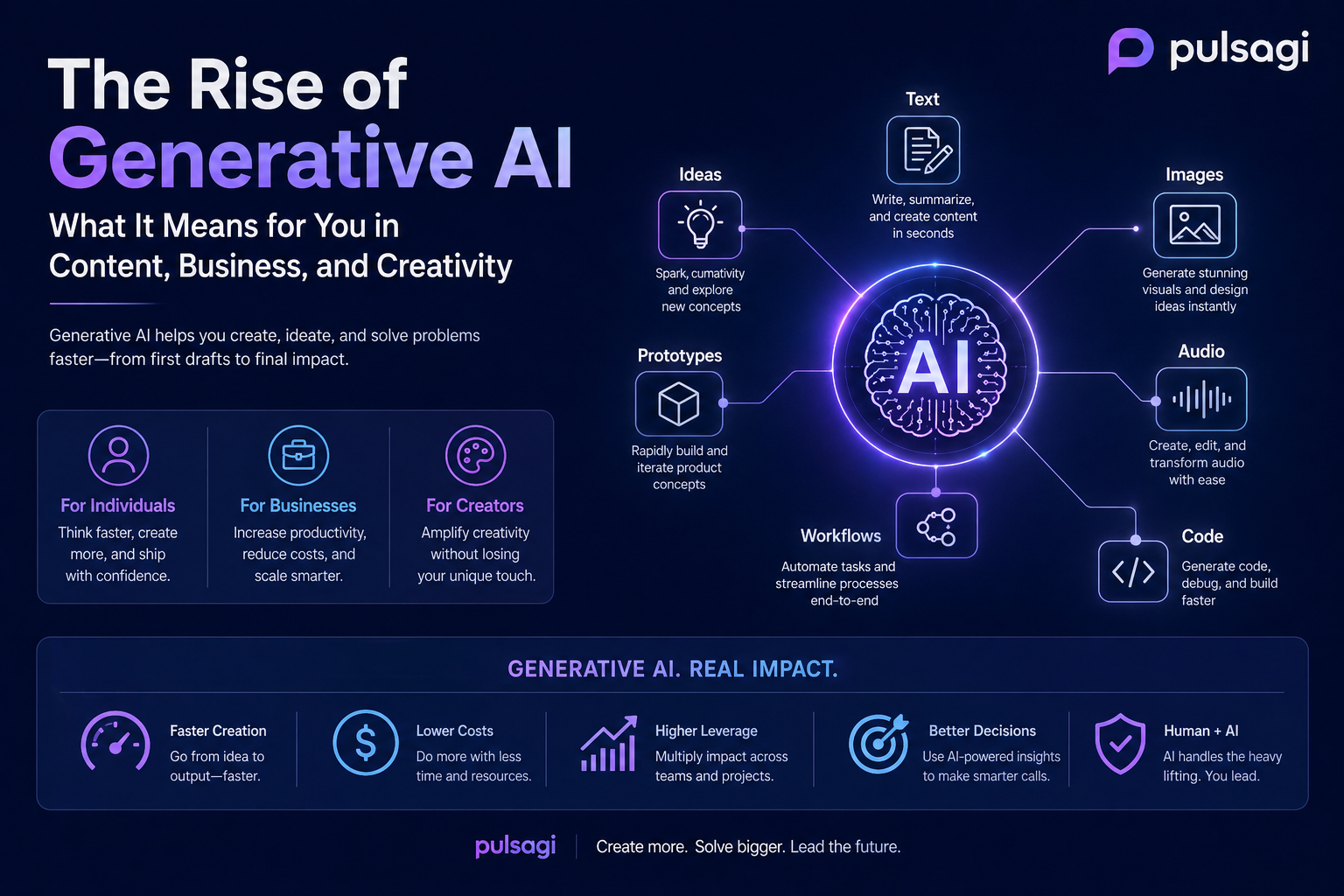
Generative AI refers to AI systems that can produce new outputs such as text, code, images, audio, video, or structured content based on prompts, examples, context, or data sources. In practice, that includes much more than creation. Good generative AI systems can also transform, rewrite, summarize, classify, expand, localize, and combine information.
That is why the impact is so broad. A technology that can convert one source asset into many useful forms has value almost anywhere knowledge work happens.
Why generative AI matters
Generative AI matters because it changes the economics of early-stage work. The first draft, first summary, first prototype, first explainer, first image concept, first support response, and first code suggestion can now be produced much faster. That does not finish the job, but it changes where human time is spent.
Business reality: McKinsey's 2025 state of AI survey says 88% of respondents report regular AI use in at least one business function, but most organizations are still in experimentation or piloting phases. That means the opportunity is real, but workflow maturity is still the bottleneck.
Key features and capabilities
| Capability | What it does | Why it matters |
|---|---|---|
| Drafting | Creates first-pass text, code, concepts, or assets from instructions. | Reduces blank-page time and accelerates throughput. |
| Transformation | Turns one format into another, such as article to email, transcript to summary, or notes to proposal. | Helps teams repurpose work across channels and stakeholders. |
| Summarization | Compresses large inputs into key takeaways or action items. | Improves speed in reading, support, research, and operations. |
| Variation generation | Produces multiple wording, design, or framing options quickly. | Useful for marketing, ideation, testing, and creative exploration. |
| Grounded assistance | Combines generation with retrieval from trusted internal or external sources. | More useful for business work than ungrounded generation alone. |
What it means for you
| If you are a... | What generative AI changes | Best response |
|---|---|---|
| Individual professional | You can research, draft, summarize, and iterate faster. | Use AI to accelerate thinking, but keep ownership of quality and judgment. |
| Business operator | You can reduce repetitive knowledge work and improve responsiveness. | Focus on process design, approvals, measurement, and grounded outputs. |
| Creative team member | You can explore concepts, references, variants, and support assets quickly. | Double down on direction, taste, originality, and editing. |
| Developer | You can accelerate code explanation, scaffolding, debugging, and documentation. | Use AI as leverage, not as a substitute for architecture or review. |
Examples and use cases
One source, many outputs
A webinar transcript can become a blog post, FAQ, customer email, LinkedIn summary, slide outline, and internal enablement note in one workflow. Generative AI is valuable not because it replaces the strategist, but because it reduces repetitive adaptation work.
Better response speed
AI can summarize call notes, draft follow-up emails, suggest objections handling, prepare meeting briefs, and compile account research. That can improve responsiveness if the information is grounded in trusted data.
Support around the code, not only code generation
Generative AI can explain unfamiliar files, draft tests, convert comments into docs, summarize logs, and propose refactors. Often the biggest time savings come from explanation and navigation rather than raw code output alone.
Faster ideation, not automatic originality
Designers, writers, and creators can use AI for moodboards, rough directions, naming options, structured brainstorming, and variant exploration. But the final quality still depends heavily on selection, refinement, storytelling, and brand sense.
Admin and developer perspective
Generative AI becomes much more valuable when it is connected to real systems and policy.
- Admins: define approved tools, data boundaries, prompt safety guidance, and retention rules.
- Developers: prioritize grounding, observability, evaluation, access control, and fallback design.
- Leaders: track time saved, quality impact, adoption, and whether AI is actually improving business outcomes.
Best practices
- Use AI for first drafts, not final truth: human review remains essential.
- Ground important outputs: connect AI to approved knowledge rather than relying on free-form recall.
- Protect sensitive data: do not feed confidential material into tools without clear policy.
- Redesign workflows: the best gains come when AI changes process steps, not only individual tasks.
- Measure value honestly: speed matters, but so do quality, compliance, trust, and rework.
Limitations
- Hallucinations: plausible output is not always correct output.
- Copyright and provenance questions: especially in visual and creative workflows.
- Prompt dependency: weak instructions often produce weak results.
- Pilot trap: many teams test generative AI widely but fail to scale because the surrounding process is unclear.
- Skill erosion risk: overuse without critical review can weaken writing, reasoning, or craft development.
Recommendation
If you are just getting started, focus on high-frequency tasks where output can be reviewed easily: summaries, first drafts, internal documents, idea generation, simple automations, and bounded support workflows. That is where generative AI usually proves value fastest.
If you are already experimenting heavily, the next step is to move from prompts to systems: grounded data, approved patterns, review flows, metrics, and reusable workflows.
My recommendation: treat generative AI as a multiplier, not a replacement for judgment. The more important the work, the more you need human direction, context, and review around the model.