
Introduction
Education has absorbed technology waves before: search, video, mobile devices, LMS platforms, online classrooms, and collaborative documents. AI is different because it can generate explanations, adapt responses, summarize information, simulate tutoring, and produce student-like output. That changes both instruction and assessment at the same time.
This article was reviewed against institutional sources available on March 23, 2026, especially UNESCO and OECD materials.
What this change really is
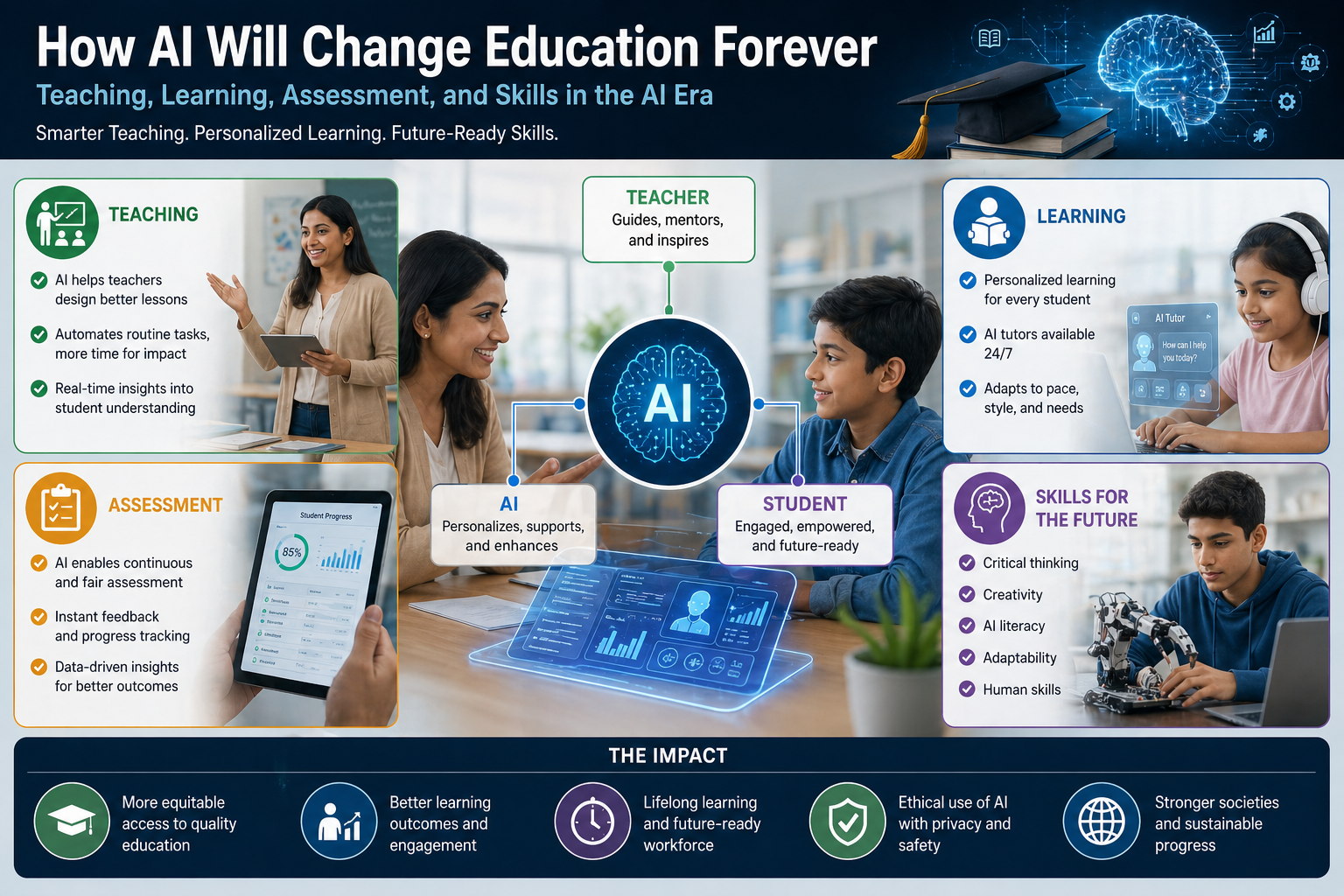
UNESCO's AI competency framework for teachers says AI has transformed the traditional teacher-student relationship into a teacher-AI-student dynamic. That framing is important because it avoids two weak narratives: one where AI is only a harmless helper, and another where teachers become irrelevant.
In reality, AI becomes a new participant in the learning environment. It can explain, suggest, scaffold, translate, summarize, and generate. But only teachers and institutions can decide how that participation is structured, supervised, disclosed, and evaluated.
Why it matters
The main reason AI matters in education is speed. It can reduce the time required to draft materials, create differentiated practice, support accessibility, and produce feedback. The second reason is scale. AI can offer support to many learners at once, which is attractive in systems facing teacher overload, skill gaps, and resource constraints.
But the same speed and scale create new risks: shallow learning, outsourcing of thinking, privacy problems, policy confusion, and assessments that no longer measure what institutions assume they measure.
Practical signal: OECD's TALIS 2024 says around 75% of teachers in Singapore and the United Arab Emirates are using AI, and those systems are also among the most likely to report professional learning in AI. Adoption and training are already linked.
How AI changes education
| Area | What changes | Why it matters |
|---|---|---|
| Lesson planning | Teachers can generate outlines, examples, differentiated activities, quizzes, and reading supports faster. | Planning time can shift from repetitive preparation toward refinement and student support. |
| Tutoring and practice | Students can receive on-demand explanations, hints, examples, and formative feedback. | This can improve practice access, especially outside the classroom. |
| Assessment | Take-home writing and generic knowledge tasks become easier to outsource to AI. | Schools need stronger oral, in-class, project-based, reflective, and process-aware assessment design. |
| Accessibility | AI can support translation, simplification, summarization, text-to-speech, and alternative explanations. | This can widen access if implemented carefully. |
| Teacher training | Educators need new skills in AI literacy, ethics, prompt design, review, and classroom policy. | Without training, institutions get uneven usage and weak governance. |
| Curriculum | Students increasingly need AI literacy, critical evaluation, and responsible use skills. | Education must now prepare learners for AI-rich workplaces and public life. |
UNESCO's guidance on generative AI in education and research explicitly points to curriculum design, teaching, learning, and research as areas affected by GenAI, which is why this is not a temporary classroom trend.
Examples across learning environments
Teacher drafts differentiated reading support
A teacher preparing one history lesson may use AI to create a standard reading summary, a simplified version for struggling readers, a quiz, a glossary, and an extension prompt for advanced students. The value is not in replacing the teacher. The value is reducing mechanical preparation time so the teacher can spend more effort on classroom interaction and support.
Assessment shifts from output to process
Instead of grading only the final essay, a university course might require source annotations, draft checkpoints, oral defense, reflective notes on AI use, and in-class application tasks. This changes the incentive structure from hidden outsourcing to visible reasoning.
AI becomes a just-in-time learning layer
In professional training, AI can help employees learn a workflow at the moment of need by summarizing SOPs, generating simulations, answering bounded questions, and proposing next steps. This is especially powerful in large organizations where documentation exists but is hard to navigate.
More ways to reach the same concept
A student with language barriers or processing differences may benefit from AI-generated plain-language summaries, translation, alternate examples, or spoken explanation. That can improve inclusion, provided accuracy and privacy are managed well.
Admin and developer perspective
| Role | What matters most | Practical takeaway |
|---|---|---|
| School or university admin | Approved tools, privacy rules, age-appropriate usage, staff training, academic integrity, and accessibility policy. | Do not leave AI adoption entirely to informal teacher experimentation. Publish guidance and support it. |
| Teacher or instructional designer | Pedagogy, disclosure, feedback quality, and redesign of assignments. | Use AI to support learning design, not to remove human mentorship from the process. |
| Developer / edtech team | LMS integration, permissions, data retention, audit trails, moderation, and reliable grounding. | Educational AI products need governance and instructional fit, not only polished demos. |
Best practices
- Train teachers explicitly: UNESCO's framework makes clear that AI competency for teachers is now a real requirement.
- Redesign assessment: if assignments can be easily generated, change the assignment model rather than pretending the environment did not change.
- Use AI for formative support first: feedback, tutoring, accessibility, and planning usually offer more immediate value than high-stakes automation.
- Define disclosure norms: students and staff should know when and how AI usage must be declared.
- Protect learner data: educational institutions must treat AI tools as data-governance decisions, not only productivity tools.
Limitations and risks
- Inaccuracy: AI can produce confident but wrong explanations.
- Equity gaps: better-supported schools and learners may benefit first, widening inequality.
- Overdependence: students may outsource struggle, reflection, and synthesis too early.
- Privacy concerns: student work, personal data, and institutional content can leak into external systems if governance is weak.
- Teacher overload during transition: policy gaps often leave educators to solve tool, ethics, and assessment issues on their own.
Recommendation
The best way to use AI in education is to treat it as a pedagogical and governance challenge, not just a software rollout. Start with teacher support, accessibility, feedback, and low-stakes learning assistance. Then redesign policy, assessment, and professional development around the new reality.
Institutions that do this well will likely combine four things: clear guidance, teacher training, approved tools, and assessment models that value reasoning, reflection, discussion, and applied judgment.
My recommendation: use AI to strengthen teaching and learning, not to sideline them. Teachers remain central, but their role becomes more strategic, more design-oriented, and more connected to digital judgment than before.