
Introduction
The best AI language depends on what you are building: a research notebook, a browser-side inference flow, a low-latency backend, a JVM-heavy enterprise platform, or a high-performance numerical stack. That is why "best language for AI" is always partly a context question.
This article was reviewed against official ecosystem documentation available on February 24, 2026. The ranking below is an editorial recommendation inferred from the maturity, breadth, and deployment fit of those ecosystems at that date.
How to evaluate an AI language
Language choice should be based on a small set of real constraints.
- Library depth: are the core ML, DL, NLP, and deployment tools available and maintained?
- Learning speed: can new practitioners become productive quickly?
- Deployment surface: browser, backend, GPU, mobile, batch, or embedded?
- Team fit: does the language match what your engineers already operate well?
- Performance requirements: some workflows need raw systems-level control.
Quick answer
| Language | Best for | Why it stands out | Watch out for |
|---|---|---|---|
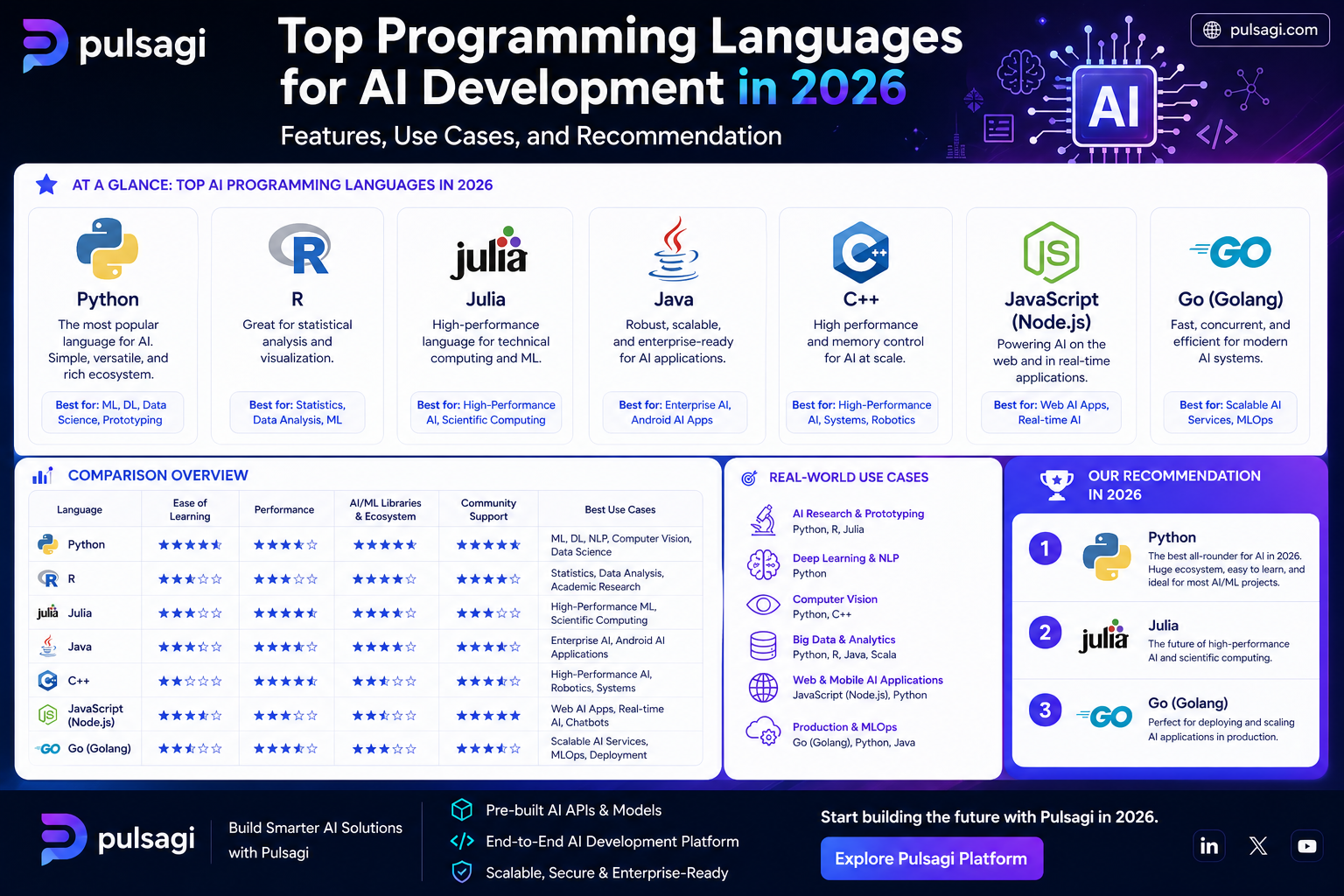
| Python | Default AI development, learning, notebooks, research, and most production pipelines. | Largest ecosystem depth across scikit-learn, PyTorch, TensorFlow, Keras, and Hugging Face. | Not every deployment surface wants Python as the final runtime. |
| JavaScript / TypeScript | Browser AI, web products, client inference, and full-stack AI UX. | TensorFlow.js and Transformers.js bring models close to the user. | Still not the first choice for the broadest model training workflows. |
| C++ | High-performance inference and low-latency systems. | Strong runtime control and close integration with major ML frameworks. | Higher complexity and slower beginner learning curve. |
| Java | JVM-heavy enterprise environments and model serving inside existing business stacks. | DJL gives Java teams a credible AI path without abandoning the JVM. | Smaller native experimentation culture than Python. |
| Julia | Numerical research and scientific machine learning. | Elegant performance-oriented scientific stack with Flux and broader Julia ecosystems. | Smaller hiring and ecosystem footprint than Python. |
Top languages in 2026
Here is the practical ranking.
1. Python
Why it matters: Python remains the default AI language because it has the broadest tooling surface, the strongest learning path, and the deepest community support across classical machine learning, deep learning, NLP, experimentation, and production services.
Best use cases: notebooks, training, evaluation, NLP, computer vision, ML APIs, data science, MLOps pipelines, and general-purpose AI development.
2. JavaScript / TypeScript
Why it matters: AI increasingly lives inside product experiences, not only on servers. JavaScript and TypeScript matter because browser and Node.js environments can now run practical models through ecosystems like TensorFlow.js and Transformers.js.
Best use cases: browser inference, client-side sentiment or classification, AI-enabled web apps, extensions, demos, and product-native interactions.
3. C++
Why it matters: C++ is not the easiest language to learn first, but it remains important for low-latency, performance-sensitive, systems-heavy AI runtimes. PyTorch's C++ frontend and broader native inference stacks make it relevant where raw control matters.
Best use cases: embedded or performance-critical inference, high-throughput serving, engine-level integration, and environments where Python is not the right runtime.
4. Java
Why it matters: Java stays relevant because many enterprises already run critical business systems on the JVM. Deep Java Library gives those teams a path to integrate model inference and training-oriented patterns in a language they already operate well.
Best use cases: enterprise backends, model integration into existing Java platforms, JVM services, and operational teams with strong Java ownership.
5. Julia
Why it matters: Julia deserves a place in the top list because of its scientific computing design, differentiable programming story, and elegant machine learning stack. It is not the broadest mainstream choice, but it is technically strong where numerical work is central.
Best use cases: numerical research, scientific ML, differentiable simulation, and high-performance experimentation where Julia expertise already exists.
Honorable mention: R
R still matters in analytics-heavy organizations, especially where tidymodels-driven workflows, statistics, and reporting are strong. It is not my primary recommendation for greenfield AI engineering, but it remains relevant for certain data science teams.
Admin and developer perspective
| Role | What matters most | Good default |
|---|---|---|
| Business admin / IT admin | Supportability, hiring, security review, and team-operable platforms. | Python for general use, Java for JVM-native operations. |
| Developer / ML engineer | Library access, experimentation speed, and deployment flexibility. | Python first, then the language closest to the runtime surface. |
| Frontend or product engineer | User experience, browser inference, and fast product integration. | JavaScript or TypeScript. |
| Systems / performance engineer | Latency, memory, and control. | C++. |
Best practices
- Do not confuse learning language with serving language: many teams train in Python and serve elsewhere.
- Choose for the workflow, not the hype: browser AI and backend AI can justify different languages.
- Respect team reality: the best technical option can still fail if no one can maintain it.
- Prefer ecosystem leverage: official framework support matters more than language ideology.
- Keep the stack small: a compact, understood toolchain usually beats a trendy multi-language sprawl.
Limitations
- This ranking is context-dependent: "best" changes with deployment surface and team shape.
- Official docs do not create a universal ranking: the ranking here is an inference from ecosystem maturity and fit.
- Language choice is not enough: data, evaluation, governance, and architecture matter more than syntax alone.
Recommendation
If you are starting fresh, learn Python first. Then add the language that matches where your AI actually needs to run: JavaScript or TypeScript for browser-first product experiences, C++ for performance-critical runtimes, Java for JVM-heavy enterprise integration, and Julia for specialized scientific computing paths.